Spongy moth infestations can be a great concern for homeowners and property managers in Pennsylvania with mature oak trees. During outbreak years, the caterpillars can defoliate entire landscapes and wooded areas in short order.
Most people notice spongy moth infestations when the caterpillars are feeding. That can be too late. The best management practices begin with knowing the life cycle, monitoring for egg masses, assessing tree health and vulnerability, and applying treatment during the most vulnerable stages of the caterpillars.
Integrated management practices focus on eradicating damaging populations, protecting the health of important trees, and applying the proper treatment at the proper time. Our insect and disease management team approaches spongy moth as part of broader plant health care and integrated pest management.
What Is a Spongy Moth?
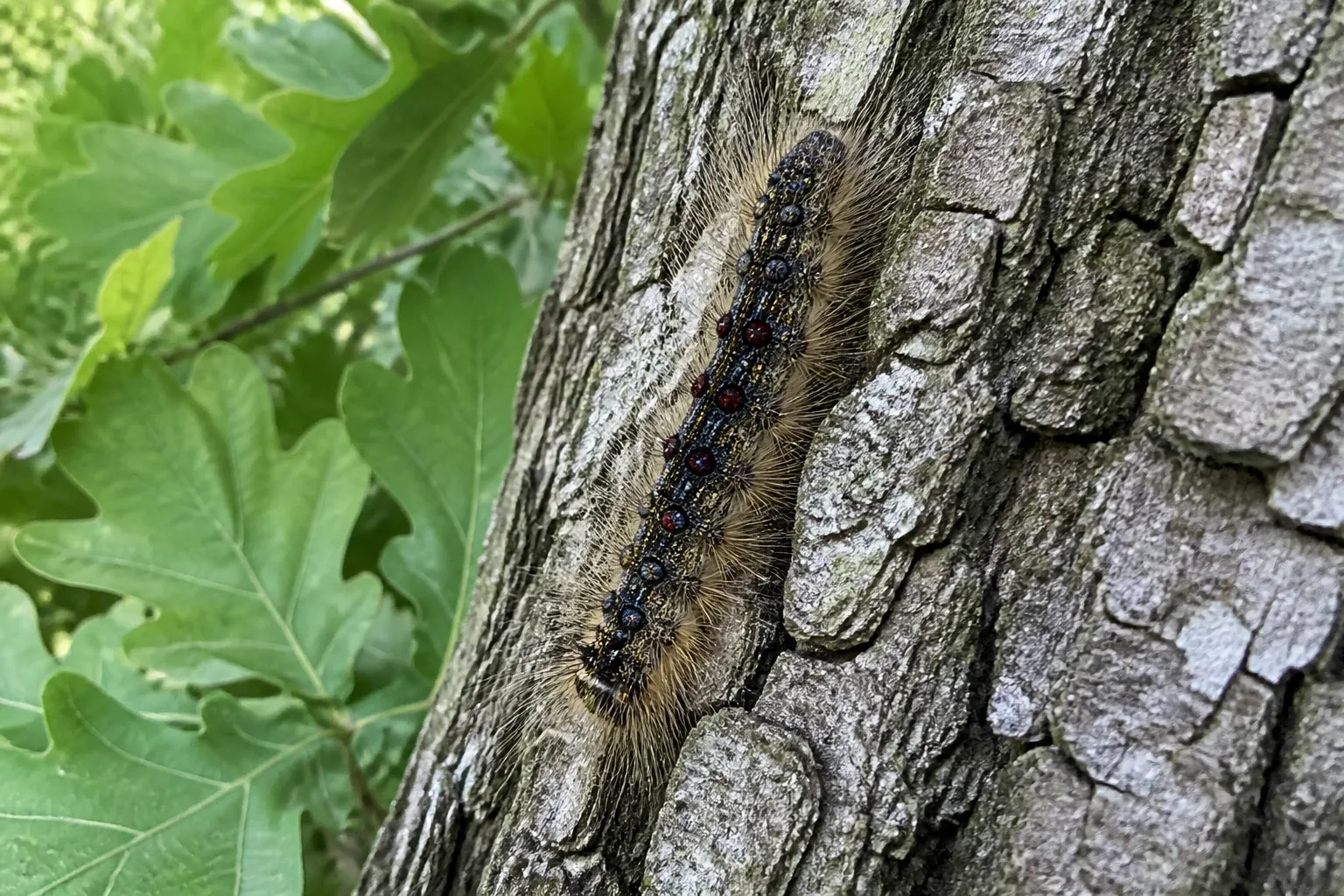
The spongy moth is an invasive species of moth that has been present in Pennsylvania and throughout the northeastern United States for decades. It was previously called the gypsy moth.
While the moth itself is not damaging to trees, the infestations are caused by the larval, or caterpillar, stage. Spongy moth caterpillars defoliate hundreds of species of trees and shrubs.
Oak trees are especially favored, so landscapes with a high population of oaks are most at risk. They will also feed on many other hardwoods, including:
- Birch
- Willow
- Apple
- Aspen
- Basswood
- Many other hardwood species
A few caterpillars here and there won't usually cause much concern. It's when caterpillar populations build and start defoliating entire trees that a problem can arise.
Spongy Moth Life Cycle
Spongy moths have a one-generation life cycle.
The adult moths lay tan, fuzzy egg masses during the summer. These egg masses can be found on:
- Tree trunks and branches
- Rocks and logs
- Buildings and sheds
- Outdoor furniture
- Firewood and other outdoor surfaces
The egg masses survive through the fall and winter. As temperatures warm in the spring and the trees leaf out, the egg masses hatch and small caterpillars emerge.
The caterpillars begin feeding shortly after hatching. Some stay close to the egg mass while others disperse to other trees on silk threads that can float on the wind.
Over the next few weeks, the caterpillars go through a number of growth stages, called instars. They get bigger as they progress through the instars and eat more as they grow. By late spring and early summer, the mature caterpillars are feeding heavily.
The caterpillars then stop feeding and enter the pupal stage. Adult moths emerge later in the summer, mate, and the females lay another generation of egg masses.
With a fairly well-understood life cycle, homeowners and property managers can be proactive against damaging spongy moth populations.
Why Caterpillar Feeding Is So Harmful
Trees can tolerate a certain amount of leaf loss. A few caterpillars defoliating a few leaves here and there won't usually cause long-term harm to a tree.
That changes when caterpillar populations build.
During outbreak years, thousands of caterpillars can defoliate entire neighborhoods, wooded lots, or landscapes. Deciduous trees can lose large amounts of foliage in a short period of time. In extreme cases, deciduous trees can be defoliated nearly completely by early summer.
While most healthy deciduous trees will produce a second set of leaves after being defoliated, they have to use stored energy to do so. That energy would otherwise go toward growth, defense, and root development.
Most healthy trees will recover from a single incident of defoliation. However, when caterpillars defoliate trees heavily year after year—or when the trees are already under stress—the damage accumulates.
Common stressors that make recovery harder include:
- Drought
- Root damage
- Compacted soil
- Construction activity near the roots
- Poor drainage
- Disease and other insect pests
Year after year of defoliation can stress trees and leave them more vulnerable to secondary issues. Conifers can be especially at risk, because many evergreen species cannot produce new foliage the way deciduous trees can.
Early Monitoring Before Caterpillars Appear
Homeowners do not have to wait until caterpillars are feeding to begin monitoring for signs of a spongy moth infestation. Egg mass monitoring can begin in the fall and winter.
Egg masses can appear on trunks, branches, rocks, logs, buildings, sheds, outdoor furniture, firewood, and many other places.
While a few egg masses may not mean much for the following spring, large numbers of egg masses on multiple trees can signal the potential for a huge caterpillar population.
By beginning monitoring early, homeowners and plant health care professionals can assess the situation before caterpillars arrive in the spring. That assessment can include:
- Counting egg masses
- Identifying trees that are most at risk
- Reviewing the health of important trees on the property
- Determining whether those trees were defoliated heavily in previous years
In some cases, monitoring may be all that is needed. In other cases, plant health care professionals may determine that spring treatment is warranted.
When egg masses are few in number and easily accessible, they can also be physically removed. Carefully scrape egg masses off surfaces and place them into bags for proper disposal. Simply knocking egg masses onto the ground may not be enough, because the eggs inside may still be viable.
Biological Sprays and Proper Treatment Timing
Biological sprays are often used to treat spongy moth caterpillars.
One biological spray that is frequently used is a strain of bacteria called Bacillus thuringiensis subspecies kurstaki, or Btk for short.
Btk is a naturally occurring bacterium used to control a select group of caterpillars. It is most effective when consumed by susceptible young caterpillars, so proper timing is key.
Since Btk is only effective against certain young caterpillar stages, it is typically applied in the spring after egg masses have hatched and the caterpillars have begun feeding.
Timing mistakes reduce results:
- Too early: caterpillars may not have hatched yet, or there may not be enough foliage for them to consume
- Too late: caterpillars may be too large and less susceptible to certain biological treatments
Treatment should not be scheduled for the same calendar date every year. Spring temperatures, local weather, elevation, stage of tree development, and other factors all affect when egg masses hatch and caterpillars begin feeding.
Proper monitoring of these conditions helps determine when spongy moths are in the vulnerable stages of their life cycle and most susceptible to treatment.
Don't Forget Overall Tree Health
When it comes to integrated pest management, it is not just about the pest.
The health of two trees being defoliated by spongy moth caterpillars can vary greatly. One healthy tree may recover easily, while another under water stress, repeated defoliation, or other stressors may not.
After defoliation, it becomes important to limit additional stress. Proper watering during dry periods and mulching may help stressed trees recover. Mulch should not be piled around the base of trees, and the root zone should not be disturbed unnecessarily.
Fertilizing stressed trees after defoliation is not always the answer. When fertilization is called for, it should be tailored to the specific needs of the tree and soil. Ongoing woody plant support often sits under tree and shrub care, and soil or root zone support may connect to tree fertilization when overall vigor is part of the plan.
Monitoring After Caterpillars Are Gone
Monitoring for spongy moths does not stop when caterpillars are no longer present.
After a tree has been defoliated, monitoring should continue for the remainder of the growing season. Watch for:
- Canopy density
- New leaf production
- Dead branches
- Premature leaf drop
- Other signs of declining tree health
As summer wears on and fall begins, start looking for new egg masses. Finding egg masses later in the year provides valuable information about the potential for a significant caterpillar population the following spring.
Since spongy moth populations naturally fluctuate, treatment does not necessarily need to occur every year. Conditions should be assessed each year before making treatment decisions.
An Integrated Spongy Moth Management Plan
There is not one single treatment plan for spongy moths.
Finding a few egg masses on landscape trees is a very different scenario from managing a wooded area with mature oaks.
The proper management plan begins with asking the right questions:
- How many egg masses are present?
- Which tree species are most at risk?
- Have those trees been defoliated in the past?
- Are they under stress?
- What stage of the spongy moth life cycle is present?
- Is treatment warranted?
- If so, when will it be most effective?
These are the foundational questions of integrated pest management.
For homeowners throughout Lancaster, Harrisburg, York, and other Central Pennsylvania communities, beginning monitoring early gives more time to assess the property.
Finding egg masses, monitoring caterpillar populations, assessing vulnerable trees, and treating when necessary—and at the proper time—can help protect important trees on your property.
If you are concerned about spongy moth activity on your property, the plant health care professionals at Tomlinson Bomberger can inspect your trees for signs of insect activity and develop a management plan tailored to your landscape. Call (717) 399-1991, use contact, or request a quote. We serve homeowners across our service areas in South-Central Pennsylvania. Browse the blog for more tree and landscape topics between visits.