Eastern hemlocks are a familiar part of Pennsylvania’s landscape. Their dense evergreen foliage provides year-round screening, shade, and structure, and mature specimens can become some of the most distinctive trees on a property.
Unfortunately, eastern hemlocks are also vulnerable to a small invasive insect that can cause significant damage when it goes unnoticed: the hemlock woolly adelgid.
Hemlock woolly adelgid is easy to overlook in its early stages. The insects themselves are extremely small, and homeowners are much more likely to notice the white, cotton-like material they produce than the insects feeding underneath it.
Knowing what to look for matters. An infestation that is identified while a tree is still healthy generally gives a plant health care professional more management options than one discovered after substantial needle loss and branch decline have already occurred. Our insect and disease management team evaluates hemlocks as part of broader plant health care.
What Is Hemlock Woolly Adelgid?
Hemlock woolly adelgid is an invasive, sap-feeding insect that attacks hemlock trees. Eastern hemlock is particularly susceptible.
The insects settle near the bases of hemlock needles and feed on plant fluids. Over time, sustained feeding can interfere with normal tree function and contribute to needle loss, reduced growth, branch dieback, and overall decline.
One reason this pest can become established before homeowners notice it is its size. Individual adelgids are difficult to see without looking closely.
Fortunately, they leave behind a much more obvious calling card.
Look for Small White Masses Under the Branches
The easiest way to identify a potential hemlock woolly adelgid infestation is to examine the underside of hemlock twigs where the needles attach.
Infested branches often develop small white masses that look like cotton, wool, or tiny white balls.
These woolly coverings protect the insects and their eggs. They are particularly noticeable during the cooler months and into spring, although remnants can remain visible for longer.
If you have hemlocks on your Central Pennsylvania property, occasionally inspecting a few lower branches is worthwhile.
Gently turn a branch over and look closely along the twig near the bases of the needles.
A few white masses deserve further investigation. A branch covered with them is a much stronger indication that hemlock woolly adelgid is established.
However, identification should come before treatment. White material on a tree is not automatically hemlock woolly adelgid, and a professional assessment can help distinguish this pest from other insects or plant problems.
What Happens to an Infested Hemlock?
Hemlock woolly adelgid damage usually develops gradually rather than appearing overnight.
A tree may initially look relatively normal even though insects are actively feeding. As the infestation progresses, homeowners may begin noticing changes such as:
Grayish or thinning foliage. Premature needle loss. Reduced new twig growth. Thinning lower branches. Branch dieback. A canopy that looks increasingly sparse.
The condition of the tree before the infestation also matters.
A mature hemlock growing in good soil with adequate moisture may respond differently than a tree already struggling with drought, compacted soil, root disturbance, poor drainage, or another health problem.
That is an important principle of plant health care. The insect is only one part of the picture.
Treating the pest while ignoring everything happening around the tree may not address the full reason the hemlock is declining.
Why Early Detection Makes a Difference
A common mistake in tree care is waiting until a tree looks severely damaged before investigating the cause.
By that point, the tree may have been under stress for several growing seasons.
Hemlocks should instead be monitored while they still look healthy. Plant health care professionals can inspect foliage, twig growth, branch density, root conditions, moisture, and pest activity to establish a clearer picture of the tree’s condition.
If hemlock woolly adelgid is found, the severity of the infestation and health of the tree can then guide the management approach.
Not every hemlock needs the exact same treatment, and treatment should not simply be applied because a hemlock exists on the property.
The objective is to identify an actual problem and respond appropriately.
Horticultural Oils and Insecticidal Soaps
Horticultural oils can be useful tools for managing hemlock woolly adelgid in certain situations.
Unlike systemic products that move through plant tissue, horticultural oils work through direct contact. Thorough coverage is therefore important.
Timing also matters.
Hemlock woolly adelgids have stages in their life cycle when they are more exposed and susceptible to contact treatments. Applications made at the appropriate stage can be considerably more useful than treating simply because a particular date appears on the calendar.
This is one reason plant health care programs rely on monitoring and pest development rather than treating every property identically.
Insecticidal soaps may also be used as contact treatments in appropriate situations.
Both approaches require the applicator to reach the areas where the insects are located. That can make contact treatments more practical for smaller hemlocks than for very large specimens where complete coverage becomes difficult.
Weather conditions, tree condition, temperature, product labeling, and surrounding plants also need to be considered before an application is made.
Systemic Treatment Options
Systemic insecticides offer another management approach.
Rather than relying entirely on direct contact with the insect, a systemic treatment is taken up by the tree. Adelgids are then exposed to the active ingredient as they feed.
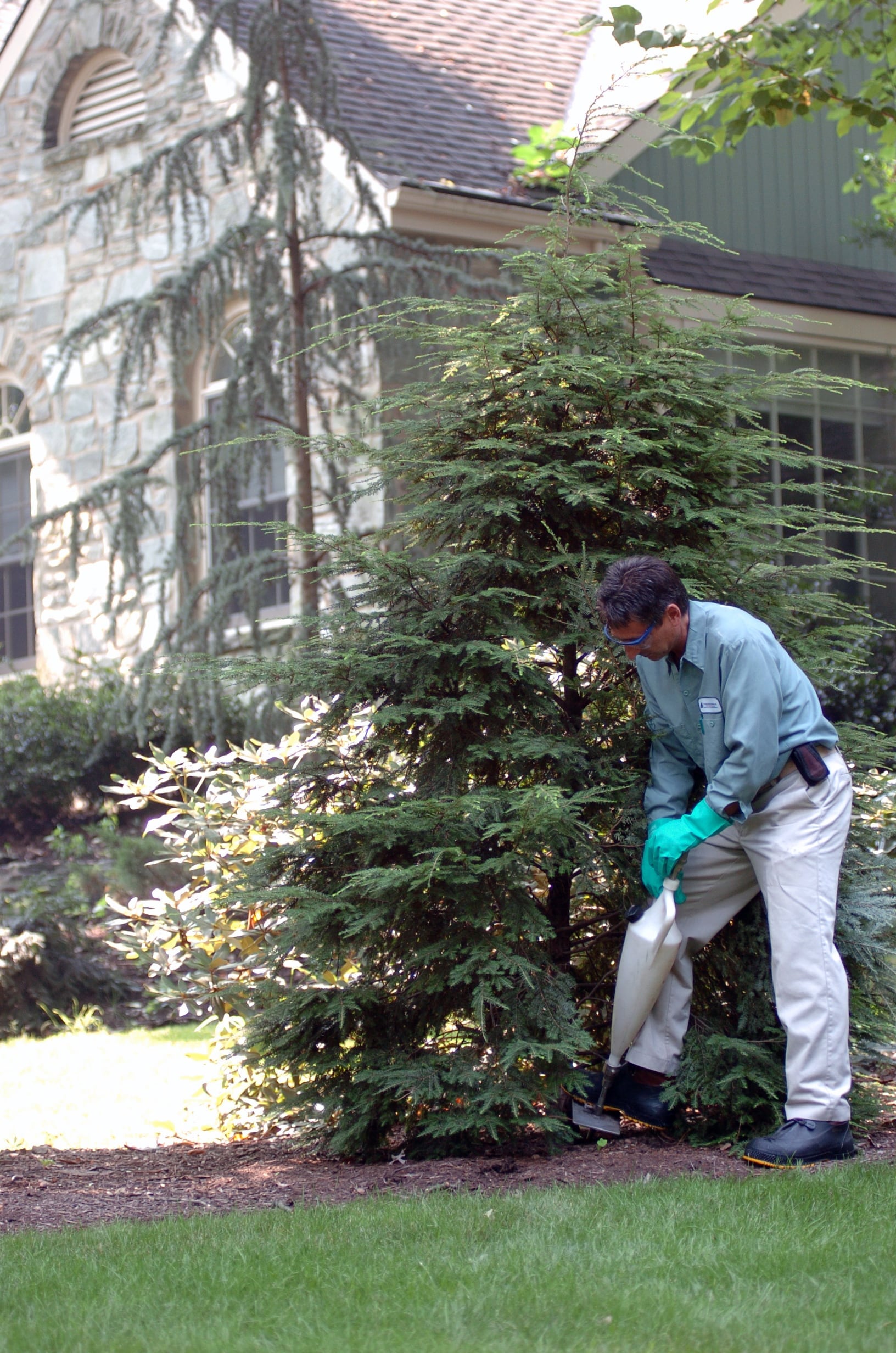
Depending on the product and circumstances, systemic treatments may be applied through the soil, the lower trunk, or other professional application methods.
These treatments can be particularly useful when managing larger or significant hemlocks where complete spray coverage would be difficult.
They are not automatically the right answer for every tree.
Soil conditions matter. Tree health matters. Proximity to water matters. The severity of the infestation matters. The specific product and application method matter.
A hemlock that has already experienced extensive canopy loss may also have a very different outlook than a vigorous tree with a relatively recent infestation.
Professional diagnosis is therefore an important part of deciding whether systemic treatment makes sense.
Biological Control and the Bigger Picture
Hemlock woolly adelgid is not simply a residential landscape problem. It affects hemlock populations throughout forests in the eastern United States.
That scale has led researchers and land managers to investigate biological control as part of long-term management.
Biological control involves using natural enemies of the adelgid, including certain predatory insects, to help suppress populations.
This is different from purchasing beneficial insects and releasing them around a single backyard tree. Biological control programs are carefully researched because introducing another organism into an ecosystem requires an understanding of what that organism eats, how it reproduces, and how it interacts with native species.
The larger goal is to develop a more sustainable balance in which natural predators contribute to controlling hemlock woolly adelgid populations.
For an individual residential property, horticultural oils, systemic treatments, monitoring, and good tree care may remain more practical tools. Biological control is nevertheless an important part of the broader effort to protect eastern hemlocks.
Do Not Forget About the Tree Itself
Controlling an insect does not eliminate every source of stress affecting a tree.
An important part of hemlock care is maintaining conditions that allow the tree to function as well as possible.
During extended dry periods, soil moisture should be monitored and supplemental watering considered when appropriate. Mulch can help conserve soil moisture and moderate soil temperatures, but it should be spread over the root zone rather than piled against the trunk.
Soil compaction around mature hemlocks should also be minimized. Parking vehicles, repeatedly operating heavy equipment, or significantly changing the grade around a tree can damage roots and reduce the movement of oxygen and water through the soil.
Fertilization requires particular care. More fertilizer does not automatically produce a healthier tree, and adding nutrients without understanding the tree's condition can be counterproductive. Plant health decisions should be based on what the tree and its growing environment actually need. Ongoing woody plant support often sits under tree and shrub care, and soil or root zone support may connect to tree fertilization when overall vigor is part of the plan.
Plant Health Care: Monitoring, Not Just Spraying
Hemlock woolly adelgid illustrates why professional plant health care is broader than pest control.
The first question should not simply be, "What should we spray?"
The better questions are: What is affecting the tree? How advanced is the problem? What other stresses are present? What stage is the pest in? Is treatment warranted? If so, which approach makes the most sense for this particular tree?
Sometimes the answer involves a contact treatment. Sometimes a systemic application is more appropriate. In other situations, improving growing conditions and continuing to monitor the tree may be part of the recommendation.
The objective is to make informed decisions based on the biology of the pest and the condition of the plant.
Keep an Eye on Your Hemlocks
Eastern hemlocks are worth paying attention to before obvious decline begins.
If you have hemlocks on your property, take a few minutes periodically to look beneath the branches. Check the bases of the needles for small white, cotton-like masses. Look at the entire canopy as well. Is it as dense as it was previously? Are lower branches thinning? Is new growth developing normally?
Changes do not necessarily mean hemlock woolly adelgid is responsible, but they are worth investigating.
Early identification gives you a better opportunity to understand what is happening and determine whether intervention is appropriate.
For homeowners throughout Lancaster, Harrisburg, York, and the surrounding areas of Central Pennsylvania, maintaining mature trees often comes down to consistent observation. A healthy-looking tree today can still benefit from monitoring, particularly when it belongs to a species facing a known pest threat.
Hemlock woolly adelgid is a serious concern, but management is not about making sweeping promises or treating every tree the same way. It is about identifying the pest correctly, understanding the condition of the tree, choosing treatments carefully, and continuing to monitor the hemlock over time.
Call (717) 399-1991, use contact, or request a quote if you are concerned about hemlocks on your property. We serve homeowners across our service areas in South-Central Pennsylvania. Browse the blog for more tree and landscape topics between visits.